

Greetings! [ Log in ] [ Register ] [ Intranet ] [ Manage Mailing Lists Subscriptions ]
  • Home
    • Ocean Leadership
  • About NOPP
    • Program Overview
      • Subtitle E – National Oceanographic Partnership Program
    • Program Updates
    • Excellence in Partnering Awards
    • Style Guide and Logos
    • Contact Us
  • Committees
    • Interagency Working Group on Ocean Partnerships (IWG-OP)
    • Interagency Working Group on Facilities and Infrastructure (IWG-FI)
    • Ocean Research Advisory Panel (ORAP)
      • ORAP Meetings
        • ORAP Meetings Prior to 2008
      • ORAP Publications and Reports
      • ORAP Membership List
      • Current ORAP Taskings
      • Sub-Panels
        • Ocean Acidification Task Force
        • ORAP Education Sub-panel
        • ORAP Industry Sub-panel
        • ORAP Ocean Observing Sub-panel
      • Special Topics
  • Funded Projects
    • PI Annual Reports
    • FY2011 Projects
      • Topic 1. Marine Mammal Detection and Monitoring
      • Topic 2. Coordinated Regional Efforts That Further the U.S. Integrated Ocean Observing System (IOOS)
    • FY2010 Projects
      • Topic 1. Improving Attachments of Electronic Data Loggers to Cetaceans
      • Topic 2. Developing Environmental Protocols and Monitoring to Support Ocean Renewable Energy and Stewardship
      • Topic 3. Exploration and Research of Mid-Atlantic Deepwater Hard Bottom Habitats and Shipwrecks with Emphasis on Canyons and Coral Communities
    • FY2009 Projects
      • Topic 1: Improving Wind Wave Predictions: Global to Regional Scales
      • Topic 2: Sensors for Measurement of Biological, Bio-Optical, Optical, or Chemical Properties of the Ocean
      • Topic 3: Improving Tropical Cyclone Intensity Forecasting
    • FY2008 Projects
      • RFP: Exploration and Research of Northern Gulf of Mexico Deepwater Natural and Artificial Hard Bottom Habitats with Emphasis on Coral Communities: Reefs, Rigs and Wrecks
      • TOPIC 3: Sensors for Measurement of Biological, Bio-Optical or Chemical Properties of the Ocean
      • TOPIC 4: Atlantic Meridional Overturning Circulation (AMOC)
    • FY2007 Projects
      • Topic 4A: Coastal Effects of a Diminished-Ice Arctic Ocean
      • Topic 4B: Marine Mammals
    • FY2006 Projects
      • TOPIC 2A: Understand, identify gaps and predict changes in the workforce for ocean sciences, technology, and operations
      • TOPIC 3A: The ARGO Project: Global Ocean Observations for Understanding and Prediction of Climate Variability
      • TOPIC 4A: An Open-Source Community Model for Coastal Sediment Transport
    • FY2005 Projects
      • Topic 1A: Fusing Multi-Sensor Regional Data to Monitor and Quantify Coastal Processes
      • Topic 4 (CHEMO III): Imvestigations of Chemosynthetic Communities on the Lower Continental Slope of the Gulf of Mexico
      • Topic 4: Assesment of Global Ocean Data Assimilation Experiment (GODAE) Boundary Conditions for Coastal Ocean Predictions
      • Topic 4A: New Methods for Detection of Fish Populations or Mapping of Fish Habitat
      • Topic 4B: Sensors for Sustained, Autonomous Meaturement of Chemical or Biological Parameters in the Ocean
    • FY2004 Projects
      • Topic 1: Achieve and Sustain an Integrated Ocean Observing System (IOOS)
      • Topic 2: Promote Lifelong Education
      • Topic 3: Modernize Ocean Infrastructure and Enhance Technology Development
    • FY2003 Projects
      • Topic 1. Achieve and Sustain an Integrated Ocean Observing System (IOOS)
      • Topic 4. Foster Interagency Partnerships to Increase and Apply Scientific Knowledge
    • FY2002 Projects
      • Topic 1: Achieve and Sustain an Integrated Ocean Observing System (IOOS)
      • Topic 2: Promote Lifelong Ocean Education
    • FY2001 Projects
      • Topic 1: Achieve and Sustain an Integrated Ocean Observing System (IOOS)
      • Topic 3: Modernize ocean infrastructure and enhance technology development.
    • FY2000 Projects
      • Topic 1: Achieve and Sustain an Integrated Ocean Observing System (IOOS)
      • Topic 3: Modernize ocean infrastructure and enhance technology development
    • FY1999 Projects
      • Topic 1: Achieve and Sustain an Integrated Ocean Observing System (IOOS)
      • Topic 3: Modernize ocean infrastructure and enhance technology development.
    • FY1998 Projects
      • Topic 1: Achieve and Sustain an Integrated Ocean Observing System (IOOS)
      • Topic 3: Modernize Ocean Infrastructure and Enhance Technology Development
    • FY1997 Projects
      • Topic 1: Achieve and sustain an Integrated Ocean Observing System (IOOS)
      • Topic 2: Promote lifelong ocean education
      • Topic 3: Modernize ocean infrastructure and enhance technology development
      • Topic 4: Foster interagency partnerships to increase and apply scientific knowledge
  • Funding Announcements
  • Publications & Reports
  • News Archive

Researchers To Develop Ocean Sanctuary ‘Noise Budget’ To Evaluate Potential Impact On Marine Life
Posted by Katie Horst on Tuesday, April 1st, 2008 at 10:31 am
Filed under: News
Share
Tweet

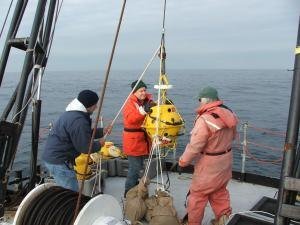
Like sentinels at their posts, an array of buoys equipped with underwater microphones and other sensors will be on duty in the Stellwagen Bank National Marine Sanctuary off the coast of Massachusetts for the next 30 months, recording sounds from whales, fish, ships and other sources around the clock.

(From ScienceDaily) — NOAA marine mammal scientists will analyze the biological sounds to help develop a global monitoring network for ocean noise, an important step in effectively managing marine sanctuary resources and protecting endangered species like the North Atlantic right whale.

“The ocean is a noisy place,” said Sofie Van Parijs, marine mammal acoustician at NOAA’s Northeast Fisheries Science Center (NEFSC) and a project scientist. “It’s full of natural sounds and those from human activities, and there is substantial evidence that the level of man-made noise is rising. Marine mammals and many fishes are highly dependent on sound for communication, navigation, foraging and predator avoidance. We need to understand how these animals, especially endangered and protected species, are impacted by sounds from many sources to be able to better manage and protect these living resources.”

An ocean-observing system consisting of ten autonomous recording units will be deployed for periods of three months, each in different parts of the Sanctuary at different times of the year, to monitor low frequency sounds. The passive-acoustic buoys, moored to the ocean floor and fully submerged, continually record ocean sounds around the clock before they pop to the surface on command so the data can be retrieved and batteries refreshed.

The three-year project began in late December with funding from the National Oceanographic Partnership Program and a team of scientists and engineers from NOAA Fisheries, NOAA Sanctuaries, the Bioacoustic Research Program at Cornell University and Marine Acoustics, Inc.  Van Parijs and NEFSC colleague Denise Risch, also a marine mammal bioacoustician, will analyze the biological sounds collected during the study, while Sanctuary scientists Leila Hatch, Michael Thompson and Dave Wiley will focus on the anthropogenic or human-produced sounds. Project leader Chris Clark of Cornell University and colleagues provide scientific guidance, hardware and software, and are working with Bill Ellison of Marine Acoustics, Inc. on modeling ocean noise propagation within the sanctuary.

The Gerry E. Studds Stellwagen Bank National Marine Sanctuary is an urban marine sanctuary located in close proximity to Boston and a densely populated coastal zone. The area has commercial fishing fleets, heavy vessel traffic, is frequented by marine mammals like endangered Northern right whales, and forms a critical feeding ground for endangered fin and humpback whales. It is also home to acoustically-sensitive marine animals like commercially important haddock and other fishes, sharks and sea turtles.

Van Parijs says the Sanctuary is a perfect place to build a case study that can provide a benchmark to scientifically evaluate the impacts and interactions between various human-produced sounds and acoustically-sensitive marine animals.

The abundance of endangered whales and human activities in the Sanctuary will help the team address many of the recommendations made by the National Research Council’s committee on the potential impacts of ambient noise in the ocean on marine mammals. The committee has cited the importance of sound in the lives of marine mammals, the potential for harm from excessive noise, and the lack of scientific data as to the amounts of noise introduced into the oceans by human activities and its potential impact on marine mammals.

“We need to ground-truth current sampling and analysis techniques and identify gaps that must be addressed prior to implementing a large-scale domestic or international monitoring program,” Van Parijs said. “The products of this project will be a suite of tools designed to be transferable for use in other ecological regions or sanctuaries along with an extensive database of sounds. This project is a first step toward a much larger goal of establishing a global passive acoustic monitoring network to measure ambient noise levels in a variety of locations.”

The first set of project buoys deployed in December were recently recovered from the northeast corner of the Sanctuary and were redeployed March 7 in the southwest corner, where endangered Northern right whales are congregating. The area is a primary nursing and feeding ground for the whales in the spring.

Ten similar buoys were used successfully in the Sanctuary in 2006 during a one-year pilot project in preparation for this study.  This is the first project to record all types of sounds over a long time period in a relatively large area in an effort to characterize the marine acoustic environment and the health of an urbanized, highly productive ecosystem.  One potential use of the information: scientists could track whale migration patterns and ship movements to help prevent collisions, a leading cause of whale mortality.

“Our goals are to map the low-frequency noise budget throughout the Sanctuary, identify and quantify the contributing sources of sounds, and determine whether or not these noises have the potential to impact endangered marine mammals and fishes,” said David Wiley, the Sanctuary’s research coordinator.  “The results from this project will have local, national and international implications.”


Related Posts:

  • NOPP Funding Announcement – U.S. Integrated Ocean Observing System-CLOSED
  • Program Update – April 2011
  • NOPP Names “Marine Mammal Detection and Monitoring” Funding Award Winners
  • NOPP Photo of the Month – Argo
  • Program Update – February 2011
« Home | « Previous Page

Follow Us

Subscribe via Twitter
245 Followers
Subscribe via Facebook
271 Fans
Subscribe via RSS
68 Readers
Subscribe via Email
Subscribe

Upcoming Events

  • No events.

What's Hot This Month

  • NOPP Photo of the Month – Tagged N. Elephant SealNOPP Photo of the Month – Tagged N. Elephant Seal : The Northern elephant seal pictured has a CTD (conductivity, temperature, depth) tag attached to it by a team of Univers...
  • NOPP Funding Announcement in Partnership with DOE – Marine and Hydrokinetic (MHK) Effects Assessment and MonitoringNOPP Funding Announcement in Partnership with DOE – Marine and Hydrokinetic (MHK) Effects Assessment and Monitoring : NOPP is pleased to announce a new funding opportunity in partnership with the Department of Energy (DOE), Office of En...
  • NOPP Funding Announcement in Partnership with ONR – Earth System Prediction Capability-CLOSEDNOPP Funding Announcement in Partnership with ONR – Earth System Prediction Capability-CLOSED : NOPP is excited to announce a new funding opportunity in partnership with the Office of Naval Research (ONR)! Fundi...
  • Teachers Navigate the WebTeachers Navigate the Web : Vicki Clark remembers how she and other Sea Grant educators used to illustrate the powers and pitfalls of the Internet f...
  • Ocean Leadership Contracted to Help Manage the Gulf Research InitiativeOcean Leadership Contracted to Help Manage the Gulf Research Initiative : Gulf of Mexico Alliance Contracts Ocean Leadership to help manage the Gulf Research Initiative...
  • Program Update – March 2013Program Update – March 2013 : The National Oceanographic Partnership Program (NOPP) Office is pleased to announce a new funding opportunity in partner...
  • National Oceanographic Partnership Program Celebrates Argo One-Millionth Ocean Observation MilestoneNational Oceanographic Partnership Program Celebrates Argo One-Millionth Ocean Observation Milestone : Innovative Global Observing System Funded Under NOPP for First 12 Years...
  • Dr. Margaret Leinen New Chair of the Ocean Research Advisory Panel  (ORAP)Dr. Margaret Leinen New Chair of the Ocean Research Advisory Panel (ORAP) : The National Oceanographic Partnership Program (NOPP) office would like to welcome Dr. Margaret Leinen, Executive Direct...
  • Program Update – May 2010Program Update – May 2010 : The Biodiversity Ad Hoc Group, of the Joint Subcommittee on Ocean Science and Technology’s (JSOST) Interagency Working G...
  • Follow-on Research Article to the Attaining an Operational Marine Biodiversity Observation Network NOPP-Hosted Workshop to be Published in BioScienceFollow-on Research Article to the Attaining an Operational Marine Biodiversity Observation Network NOPP-Hosted Workshop to be Published in BioScience : Members of the steering committee from the 2010 NOPP-hosted workshop Attaining an Operational Marine Biodiversity Obse...

Archives

Visitors Online

3 Users Online

NOPP-Funded Project Websites

  • ARGO
  • BRIDGE
  • CHEMO III
  • DECAF
  • ECCO
  • FleetLink
  • GODAE
  • HYCOM
  • MISST
  • NearCoM
  • NOPP Drifters
  • OSTO Workforce Study

Recent Posts

  • Follow-on Research Article to the Attaining an Operational Marine Biodiversity Observation Network NOPP-Hosted Workshop to be Published in BioScience
  • Program Update – March 2013
  • NOPP Funding Announcement in Partnership with DOE – Marine and Hydrokinetic (MHK) Effects Assessment and Monitoring
  • NOPP Funding Announcement in Partnership with ONR – Earth System Prediction Capability-CLOSED
  • Argo Global Ocean Project Takes Underwater Monitoring to a New Level

RSS Latest From Ocean Leadership

  • ONW: Week of May 13, 2013 – Number 202
  • Bob Gagosian – From the President’s Office: 5-16-2013
  • Lowering Ocean Temperatures Helps Save Coral Reefs
  • Amazing Sea Butterflies Are the Ocean’s Canary in the Coal Mine
  • Why Warming Oceans Could Mean Dwindling Fish

RSS Latest from ScienceDaily

  • Resistance to last-line antibiotic makes bacteria resistant to immune system
  • Early-life traffic-related air pollution exposure linked to hyperactivity
  • 'Whodunnit' of Irish potato famine solved
  • New NOAA report examines national oil pollution threat from shipwrecks
  • The mammoth's lament: How cosmic impact sparked devastating climate change
QR Code Business Card Web design by Will Ramos | © Copyright National Oceanographic Partnership Program (NOPP) 2007-2012. All Rights Reserved. | 123 queries in 0.625 seconds.