

Greetings! [ Log in ] [ Register ] [ Intranet ] [ Manage Mailing Lists Subscriptions ]
  • Home
    • Ocean Leadership
  • About NOPP
    • Program Overview
      • Subtitle E – National Oceanographic Partnership Program
    • Program Updates
    • Excellence in Partnering Awards
    • Style Guide and Logos
    • Contact Us
  • Committees
    • Interagency Working Group on Ocean Partnerships (IWG-OP)
    • Interagency Working Group on Facilities and Infrastructure (IWG-FI)
    • Ocean Research Advisory Panel (ORAP)
      • ORAP Meetings
        • ORAP Publications and Reports
      • Sub-Groups
        • Ocean Acidification Task Force
        • ORAP Education Sub-panel
        • ORAP Industry Sub-panel
        • ORAP Ocean Observing Sub-panel
  • Funded Projects
    • PI Annual Reports
    • FY2011 Projects
      • Topic 1. Marine Mammal Detection and Monitoring
      • Topic 2. Coordinated Regional Efforts That Further the U.S. Integrated Ocean Observing System (IOOS)
    • FY2010 Projects
      • Topic 1. Improving Attachments of Electronic Data Loggers to Cetaceans
      • Topic 2. Developing Environmental Protocols and Monitoring to Support Ocean Renewable Energy and Stewardship
      • Topic 3. Exploration and Research of Mid-Atlantic Deepwater Hard Bottom Habitats and Shipwrecks with Emphasis on Canyons and Coral Communities
    • FY2009 Projects
      • Topic 1: Improving Wind Wave Predictions: Global to Regional Scales
      • Topic 2: Sensors for Measurement of Biological, Bio-Optical, Optical, or Chemical Properties of the Ocean
      • Topic 3: Improving Tropical Cyclone Intensity Forecasting
    • FY2008 Projects
      • RFP: Exploration and Research of Northern Gulf of Mexico Deepwater Natural and Artificial Hard Bottom Habitats with Emphasis on Coral Communities: Reefs, Rigs and Wrecks
      • TOPIC 3: Sensors for Measurement of Biological, Bio-Optical or Chemical Properties of the Ocean
      • TOPIC 4: Atlantic Meridional Overturning Circulation (AMOC)
    • FY2007 Projects
      • Topic 4A: Coastal Effects of a Diminished-Ice Arctic Ocean
      • Topic 4B: Marine Mammals
    • FY2006 Projects
      • TOPIC 2A: Understand, identify gaps and predict changes in the workforce for ocean sciences, technology, and operations
      • TOPIC 3A: The ARGO Project: Global Ocean Observations for Understanding and Prediction of Climate Variability
      • TOPIC 4A: An Open-Source Community Model for Coastal Sediment Transport
    • FY2005 Projects
      • Topic 1A: Fusing Multi-Sensor Regional Data to Monitor and Quantify Coastal Processes
      • Topic 4 (CHEMO III): Imvestigations of Chemosynthetic Communities on the Lower Continental Slope of the Gulf of Mexico
      • Topic 4: Assesment of Global Ocean Data Assimilation Experiment (GODAE) Boundary Conditions for Coastal Ocean Predictions
      • Topic 4A: New Methods for Detection of Fish Populations or Mapping of Fish Habitat
      • Topic 4B: Sensors for Sustained, Autonomous Meaturement of Chemical or Biological Parameters in the Ocean
    • FY2004 Projects
      • Topic 1: Achieve and Sustain an Integrated Ocean Observing System (IOOS)
      • Topic 2: Promote Lifelong Education
      • Topic 3: Modernize Ocean Infrastructure and Enhance Technology Development
    • FY2003 Projects
      • Topic 1. Achieve and Sustain an Integrated Ocean Observing System (IOOS)
      • Topic 4. Foster Interagency Partnerships to Increase and Apply Scientific Knowledge
    • FY2002 Projects
      • Topic 1: Achieve and Sustain an Integrated Ocean Observing System (IOOS)
      • Topic 2: Promote Lifelong Ocean Education
    • FY2001 Projects
      • Topic 1: Achieve and Sustain an Integrated Ocean Observing System (IOOS)
      • Topic 3: Modernize ocean infrastructure and enhance technology development.
    • FY2000 Projects
      • Topic 1: Achieve and Sustain an Integrated Ocean Observing System (IOOS)
      • Topic 3: Modernize ocean infrastructure and enhance technology development
    • FY1999 Projects
      • Topic 1: Achieve and Sustain an Integrated Ocean Observing System (IOOS)
      • Topic 3: Modernize ocean infrastructure and enhance technology development.
    • FY1998 Projects
      • Topic 1: Achieve and Sustain an Integrated Ocean Observing System (IOOS)
      • Topic 3: Modernize Ocean Infrastructure and Enhance Technology Development
    • FY1997 Projects
      • Topic 1: Achieve and sustain an Integrated Ocean Observing System (IOOS)
      • Topic 2: Promote lifelong ocean education
      • Topic 3: Modernize ocean infrastructure and enhance technology development
      • Topic 4: Foster interagency partnerships to increase and apply scientific knowledge
  • Funding Announcements
  • Publications & Reports
  • News Archive
  • Forum
  • Members Only

Glider Completes Historic Ocean Crossing: New Technology Advances Climate Understanding
Posted by Katie Horst on Monday, December 7th, 2009 at 10:28 am
Filed under: News
Share


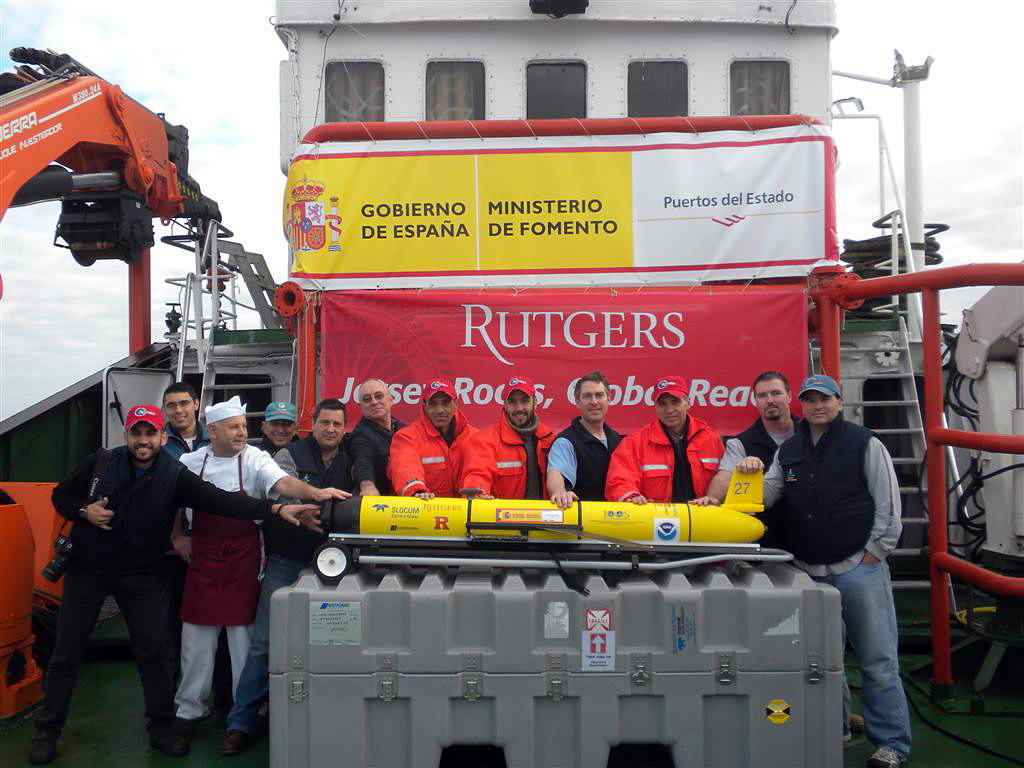
(Click to enlarge image) The Scarlet Knight was picked up at 9 a.m. local time Friday off the Spanish coast by the M/V Investigador. The glider's designers, builders and project oceanographers were on hand for the retrieval. (Credit: Rutgers University)

The first-ever 7,300-mile Atlantic Ocean crossing by an unmanned underwater glider is opening up a new world of ocean technology.


(From NOAA) — A ceremony on Dec. 9 in Baiona, Spain, will celebrate the partnership effort among the U.S. interagency Integrated Ocean Observing System (IOOS) through Rutgers University, NOAA, Puertos Del Estado (Spanish Port Authority), the National Oceanographic Partnership Program, and other European partners.

“The success of this mission marks an important milestone in ocean observing and opens new frontiers in oceanography,” said Richard Spinrad, NOAA assistant administrator for oceanic and atmospheric research. “It is through efforts like this that we will continue to learn more about the wonders of the ocean at a critical time for our planet.”

The glider, launched off the coast of New Jersey last April, repeatedly dove to depths of up to 200 meters to collect data including temperature, salinity and density. Scientists correlate these data with those from satellite imagery and altimetry, radar systems and seafloor and buoy-mounted sensors to get a more detailed view of a particular patch of ocean in near real time. The glider’s constant motion offers a more comprehensive view of ocean conditions in time and space than the static measurements usually taken from the deck of a ship.

(Click to enlarge image) Glider recovery. (Credit: Rutgers University)

(Click to enlarge image) Glider recovery. (Credit: Rutgers University)

“This data will help us understand what is happening in the ocean, including where and how quickly changes are occurring,” said Zdenka Willis, director of NOAA’s IOOS program. “Collecting this vital data at sea is usually difficult and expensive, but gliders and their evolving and expanding capabilities are now allowing us to explore the ocean in a safer and more economic way.”

The glider was built with custom upgrades that allowed it to dive deeper, track battery life and minimize fouling of instruments due to marine growth. Oceanography undergraduates at Rutgers University were significantly involved in this mission as part of their education program.

Nicknamed the Scarlet Knight, the 7 foot-long, 135-pound glider traversed the ocean over 221 days. A similar attempt was made last year, but that glider was lost around the Azores.

(Click to enlarge image) Glider in flight. (Credit: Rutgers University)

(Click to enlarge image) Glider in flight. (Credit: Rutgers University)

Other partners in the project include Teledyne Webb Research, Universidad de Las Palmas de Gran Canaria, Platforma Oceanica de Canarias, and the Universidade dos Acores, Departamento de Oceanografia e Pescas.

Baiona is where Christopher Columbus first announced to Europe the existence of the New World in 1493.

IOOS delivers the data and information decision makers need to take action to improve safety, enhance the economy and protect the environment. These data provide a larger picture of the interactions between the ocean and atmosphere and advance our understanding of potential climate change impacts on marine ecosystems and coastal communities.

NOAA understands and predicts changes in the Earth’s environment, from the depths of the ocean to the surface of the sun, and conserves and manages our coastal and marine resources.


Related Posts:

  • NOPP Funding Announcement – U.S. Integrated Ocean Observing System-CLOSED
  • Deep-sea Glider
  • U.S. Navy Opens Nominations for ORAP Membership
  • Interagency Working Group on Ocean Partnership’s Attaining an Operational Marine Biodiversity Observation Network Report Released
  • NOPP Photo of the Month – Argo
« Home | « Previous Page

Follow Us

Subscribe via Twitter
114 Followers
Subscribe via Facebook
160 Fans
Subscribe via RSS
57 Readers
Subscribe via Email
Subscribe

Upcoming Events

  • No events.

What's Hot This Month

  • BOEM Releases Science Day PresentationsBOEM Releases Science Day Presentations: The Bureau of Ocean Energy Management (BOEM) has released the presentations from Science Day, which was hosted at the ...
  • NOPP Photo of the Month – Tagged N. Elephant SealNOPP Photo of the Month – Tagged N. Elephant Seal: The Northern elephant seal pictured has a CTD (conductivity, temperature, depth) tag attached to it by a team of Univers...
  • First Legal Roadmap to Tackle Local Ocean Acidification HotspotsFirst Legal Roadmap to Tackle Local Ocean Acidification Hotspots: Coastal communities hard hit by ocean acidification hotspots have more options than they may realize, says an interdisci...
  • Program Update – Year in Review 2011Program Update – Year in Review 2011: The National Oceanographic Partnership Program (NOPP) Office had another busy year in 2011, continuing to support the In...
  • BOEMRE, NOAA and USGS Launch Maritime Science Expedition off Mid-Atlantic Coast Aboard the Research Ship Nancy FosterBOEMRE, NOAA and USGS Launch Maritime Science Expedition off Mid-Atlantic Coast Aboard the Research Ship Nancy Foster: Expedition using sonar to map deepwater canyons, and to identify sensitive biological habitats, coral communities and ar...
  • National Ocean Council Strategic Action Plan Outlines Available for CommentNational Ocean Council Strategic Action Plan Outlines Available for Comment: The National Policy for the Stewardship of the Ocean, our Coasts, and the Great Lakes prioritizes nine objectives to add...
  • NOPP Names “Marine Mammal Detection and Monitoring” Funding Award WinnersNOPP Names “Marine Mammal Detection and Monitoring” Funding Award Winners: Scientists from Four Universities Awarded Multiple-Year Funds for Marine Mammal Detection, Classification and Localizati...
  • NOPP Photo of the Month – Gulf of Mexico Deepwater Corals and HabitatNOPP Photo of the Month – Gulf of Mexico Deepwater Corals and Habitat: The deepwater coral pictured was taken in the Gulf of Mexico lease block Green Canyon 354 at 525 m as part of the FY 08 ...
  • Dr. Margaret Leinen New Chair of the Ocean Research Advisory Panel  (ORAP)Dr. Margaret Leinen New Chair of the Ocean Research Advisory Panel (ORAP): The National Oceanographic Partnership Program (NOPP) office would like to welcome Dr. Margaret Leinen, Executive Direct...
  • Program Update – May 2010Program Update – May 2010: The Biodiversity Ad Hoc Group, of the Joint Subcommittee on Ocean Science and Technology’s (JSOST) Interagency Working G...

Archives

Visitors Online

4 Users Online

NOPP-Funded Project Websites

  • ARGO
  • BRIDGE
  • CHEMO III
  • DECAF
  • ECCO
  • FleetLink
  • GODAE
  • HYCOM
  • MISST
  • NearCoM
  • NOPP Drifters
  • OSTO Workforce Study

Recent Posts

  • BOEM Releases Science Day Presentations
  • Program Update – Year in Review 2011
  • Program Update – November 2011
  • Bureau of Ocean Energy Management Atlantic Wind Energy Workshop Report Released
  • Program Update – October 2011

RSS Latest From Ocean Leadership

  • Opportunity: Environmental Defense Fund Director – Gulf and Southeast Oceans Program, Austin, TX
  • Opportunity: Post-Doctoral Research Scientist, Texas A&M Corpus Christi
  • Opportunity: President and Director, Bermuda Institute of Ocean Sciences (BIOS)
  • ONW: Week of January 30, 2012 – Number 154
  • From the President’s Office – 2/2/2012

RSS Latest from ScienceDaily

  • Whole exome sequencing identifies cause of metabolic disease
  • Discovery of extremely long-lived proteins may provide insight into cell aging and neurodegenerative diseases
  • A lonely heart can make you sick: Middle aged divorced women vulnerable to contracting HIV
  • Schooling protects refugee children from disease
  • The complex relationship between memory and silence
QR Code Business Card Web design by Will Ramos | © Copyright National Oceanographic Partnership Program (NOPP) 2007-2012. All Rights Reserved. | 139 queries in 1.500 seconds.