

Greetings! [ Log in ] [ Register ] [ Intranet ] [ Manage Mailing Lists Subscriptions ]
  • Home
    • Ocean Leadership
  • About NOPP
    • Program Overview
      • Subtitle E – National Oceanographic Partnership Program
    • Program Updates
    • Excellence in Partnering Awards
    • Style Guide and Logos
    • Contact Us
  • Committees
    • Interagency Working Group on Ocean Partnerships (IWG-OP)
    • Interagency Working Group on Facilities and Infrastructure (IWG-FI)
    • Ocean Research Advisory Panel (ORAP)
      • ORAP Meetings
        • ORAP Publications and Reports
      • Sub-Groups
        • Ocean Acidification Task Force
        • ORAP Education Sub-panel
        • ORAP Industry Sub-panel
        • ORAP Ocean Observing Sub-panel
  • Funded Projects
    • PI Annual Reports
    • FY2011 Projects
      • Topic 1. Marine Mammal Detection and Monitoring
      • Topic 2. Coordinated Regional Efforts That Further the U.S. Integrated Ocean Observing System (IOOS)
    • FY2010 Projects
      • Topic 1. Improving Attachments of Electronic Data Loggers to Cetaceans
      • Topic 2. Developing Environmental Protocols and Monitoring to Support Ocean Renewable Energy and Stewardship
      • Topic 3. Exploration and Research of Mid-Atlantic Deepwater Hard Bottom Habitats and Shipwrecks with Emphasis on Canyons and Coral Communities
    • FY2009 Projects
      • Topic 1: Improving Wind Wave Predictions: Global to Regional Scales
      • Topic 2: Sensors for Measurement of Biological, Bio-Optical, Optical, or Chemical Properties of the Ocean
      • Topic 3: Improving Tropical Cyclone Intensity Forecasting
    • FY2008 Projects
      • RFP: Exploration and Research of Northern Gulf of Mexico Deepwater Natural and Artificial Hard Bottom Habitats with Emphasis on Coral Communities: Reefs, Rigs and Wrecks
      • TOPIC 3: Sensors for Measurement of Biological, Bio-Optical or Chemical Properties of the Ocean
      • TOPIC 4: Atlantic Meridional Overturning Circulation (AMOC)
    • FY2007 Projects
      • Topic 4A: Coastal Effects of a Diminished-Ice Arctic Ocean
      • Topic 4B: Marine Mammals
    • FY2006 Projects
      • TOPIC 2A: Understand, identify gaps and predict changes in the workforce for ocean sciences, technology, and operations
      • TOPIC 3A: The ARGO Project: Global Ocean Observations for Understanding and Prediction of Climate Variability
      • TOPIC 4A: An Open-Source Community Model for Coastal Sediment Transport
    • FY2005 Projects
      • Topic 1A: Fusing Multi-Sensor Regional Data to Monitor and Quantify Coastal Processes
      • Topic 4 (CHEMO III): Imvestigations of Chemosynthetic Communities on the Lower Continental Slope of the Gulf of Mexico
      • Topic 4: Assesment of Global Ocean Data Assimilation Experiment (GODAE) Boundary Conditions for Coastal Ocean Predictions
      • Topic 4A: New Methods for Detection of Fish Populations or Mapping of Fish Habitat
      • Topic 4B: Sensors for Sustained, Autonomous Meaturement of Chemical or Biological Parameters in the Ocean
    • FY2004 Projects
      • Topic 1: Achieve and Sustain an Integrated Ocean Observing System (IOOS)
      • Topic 2: Promote Lifelong Education
      • Topic 3: Modernize Ocean Infrastructure and Enhance Technology Development
    • FY2003 Projects
      • Topic 1. Achieve and Sustain an Integrated Ocean Observing System (IOOS)
      • Topic 4. Foster Interagency Partnerships to Increase and Apply Scientific Knowledge
    • FY2002 Projects
      • Topic 1: Achieve and Sustain an Integrated Ocean Observing System (IOOS)
      • Topic 2: Promote Lifelong Ocean Education
    • FY2001 Projects
      • Topic 1: Achieve and Sustain an Integrated Ocean Observing System (IOOS)
      • Topic 3: Modernize ocean infrastructure and enhance technology development.
    • FY2000 Projects
      • Topic 1: Achieve and Sustain an Integrated Ocean Observing System (IOOS)
      • Topic 3: Modernize ocean infrastructure and enhance technology development
    • FY1999 Projects
      • Topic 1: Achieve and Sustain an Integrated Ocean Observing System (IOOS)
      • Topic 3: Modernize ocean infrastructure and enhance technology development.
    • FY1998 Projects
      • Topic 1: Achieve and Sustain an Integrated Ocean Observing System (IOOS)
      • Topic 3: Modernize Ocean Infrastructure and Enhance Technology Development
    • FY1997 Projects
      • Topic 1: Achieve and sustain an Integrated Ocean Observing System (IOOS)
      • Topic 2: Promote lifelong ocean education
      • Topic 3: Modernize ocean infrastructure and enhance technology development
      • Topic 4: Foster interagency partnerships to increase and apply scientific knowledge
  • Funding Announcements
  • Publications & Reports
  • News Archive
  • Forum
  • Members Only

Monmouth University President Takes on New Role
Posted by Katie Horst on Tuesday, October 20th, 2009 at 10:35 am
Filed under: News
Share

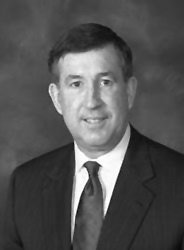
Paul G. Gaffney II - One of the U.S. Navy's most respected oceanographers.

For the better part of three decades, Paul G. Gaffney II toured the world’s oceans — above and below — as one of the U.S. Navy’s most respected oceanographers.

(From APP.com / by  Carol Gorga Williams) — But he did so largely anonymously until a group of colleagues approached the U.S. Board of Geographic Names with an idea: Name an undersea ridge deep in the South China Sea after the current president of Monmouth University.

Gaffney Ridge sits about 220 miles west of the Philippines in an area where Gaffney spent most of his career.

Now the retired vice admiral, who came to Monmouth University in July 2003 after stints as head of oceanography for the Navy and later, as leader of the Office of Naval Research, is getting his feet wet again, so to speak.

Gaffney, who served on the U.S Commission on Ocean Policy, has been named head of the Ocean Research & Resources Advisory Panel, which provides independent advice and guidance to leaders of more than 25 federal agencies whose missions involve ocean science and management.

“Paying attention to what goes on in the ocean, especially the oceans bounding the U.S., is critically important,” Gaffney said during a recent interview. “”We are the greatest maritime nation in the history of the world, and part of that is because of our position between two oceans.”

Gaffney, who will serve a two-year term as panel chair, noted the U.S.’s relationship to a third ocean.

The Arctic is already “an incredible important ocean as we try to sort out what is going on with climate change. . . . Climate change, whether you like it or not, can have big consequences on commerce and our way of life, regardless of which side of the issue you take,” he said.

During its August meeting in Washington, D.C., the panel focused on issues such as an enhanced integrated ocean observing system, offshore renewable energy, ecosystem management and climate and ocean measurements in the Arctic.

Recent ORAP priorities have included discussions on education and ocean industries and about ocean observing.

“What that means is what the federal government is doing to observe the ocean on some regular coordinated basis, just like we do the weather,” said Gaffney, who presides over a diverse panel that includes educators, scientists, ocean industries representatives and government employees and retirees.

Gaffney said the panel also will likely be asked to examine the issue of ocean acidification, which occurs when carbon dioxide from the air mixes with water, making the oceans more acidic and making it more difficult for marine life to survive.

“A new topic for us is marine spatial planning,” Gaffney said. “You would call this zoning or land use planning if it was in the borough. It is to help manage the uses of the ocean.”

The panel’s charge takes in the coastline as well as the Great Lakes. ORAP also prepared a long memo for the Obama transition team. The memo dealt with issues such as obtaining food from the ocean, ocean pollution, severe storms, maritime trade, port navigation, ocean diplomacy and national security. Climate change and renewable and nonrenewable sources of energy also would dominate policy discussions, the memo said.

Obama in June created an Interagency Policy Task Force empowered to create a national policy for dealing with ocean issues. Gaffney has testified before the task force.

“We can’t write checks or pass legislation, but we do make recommendations,” Gaffney said. “There is a federal research priorities plan that is being updated now. The whole research scheme will be written over the next year. We will participate in that.”

Gaffney is no stranger to research. In 2001, he received the Navigator Award from the Potomac Institute. The award noted Gaffney “”completely restructured Naval research through the Future Naval Capabilities process, allowing for better discoveries and for more rapid transition to the warfighter. He also successfully led the protection of vital basic national science investments.”

Gaffney, who served as head of the Naval Meteorology and Oceanography Command, retired from the military after a stint as head of the National Defense University that ended in 2003 when he came to Monmouth.

“Our consistent theme, while we cover many, many aspects of ocean research and management (and echoed in the U.S. Commission on Ocean Policy report) is we don’t understand enough about what is going on in the ocean, especially when compared with what we understand about the land and the atmosphere,” Gaffney said. “We should be collecting data routinely and that data should inform policy making.”

A 1968 graduate of the U.S. Naval Academy, with graduate degrees in mechanical engineering and business administration, Gaffney believes he still has something to learn and something to teach about the oceans he traveled for so long.

The oceans are having profound effects on the quality of life in this country, even for people who live far inland, Gaffney said. Problems in the Gulf of Mexico, for example, can be traced to runoff from farmland in the upper Midwest.

“It is really a national issue,” he said. “So much of our quality of life and our financial well being is tied to the oceans. In our own area, every person living in New Jersey lives in a coastal watershed county. Something we do in every county can affect the ocean via the Hudson or Delaware rivers or the coast. Marine transportation and recreation are huge industries for this whole state. Not to understand all the implications of all of this is just crazy.”


Related Posts:

  • Monmouth University President Assumes Leadership Role of Federal Advisory Committee
  • U.S. Navy Opens Nominations for ORAP Membership
  • Dr. Margaret Leinen New Chair of the Ocean Research Advisory Panel (ORAP)
  • Newly Established Ocean Acidification Task Force Holds First Meeting
  • Program Update – June 2011
« Home | « Previous Page

Follow Us

Subscribe via Twitter
114 Followers
Subscribe via Facebook
160 Fans
Subscribe via RSS
57 Readers
Subscribe via Email
Subscribe

Upcoming Events

  • No events.

What's Hot This Month

  • BOEM Releases Science Day PresentationsBOEM Releases Science Day Presentations: The Bureau of Ocean Energy Management (BOEM) has released the presentations from Science Day, which was hosted at the ...
  • NOPP Photo of the Month – Tagged N. Elephant SealNOPP Photo of the Month – Tagged N. Elephant Seal: The Northern elephant seal pictured has a CTD (conductivity, temperature, depth) tag attached to it by a team of Univers...
  • First Legal Roadmap to Tackle Local Ocean Acidification HotspotsFirst Legal Roadmap to Tackle Local Ocean Acidification Hotspots: Coastal communities hard hit by ocean acidification hotspots have more options than they may realize, says an interdisci...
  • Program Update – Year in Review 2011Program Update – Year in Review 2011: The National Oceanographic Partnership Program (NOPP) Office had another busy year in 2011, continuing to support the In...
  • BOEMRE, NOAA and USGS Launch Maritime Science Expedition off Mid-Atlantic Coast Aboard the Research Ship Nancy FosterBOEMRE, NOAA and USGS Launch Maritime Science Expedition off Mid-Atlantic Coast Aboard the Research Ship Nancy Foster: Expedition using sonar to map deepwater canyons, and to identify sensitive biological habitats, coral communities and ar...
  • National Ocean Council Strategic Action Plan Outlines Available for CommentNational Ocean Council Strategic Action Plan Outlines Available for Comment: The National Policy for the Stewardship of the Ocean, our Coasts, and the Great Lakes prioritizes nine objectives to add...
  • NOPP Names “Marine Mammal Detection and Monitoring” Funding Award WinnersNOPP Names “Marine Mammal Detection and Monitoring” Funding Award Winners: Scientists from Four Universities Awarded Multiple-Year Funds for Marine Mammal Detection, Classification and Localizati...
  • NOPP Photo of the Month – Gulf of Mexico Deepwater Corals and HabitatNOPP Photo of the Month – Gulf of Mexico Deepwater Corals and Habitat: The deepwater coral pictured was taken in the Gulf of Mexico lease block Green Canyon 354 at 525 m as part of the FY 08 ...
  • Dr. Margaret Leinen New Chair of the Ocean Research Advisory Panel  (ORAP)Dr. Margaret Leinen New Chair of the Ocean Research Advisory Panel (ORAP): The National Oceanographic Partnership Program (NOPP) office would like to welcome Dr. Margaret Leinen, Executive Direct...
  • Program Update – May 2010Program Update – May 2010: The Biodiversity Ad Hoc Group, of the Joint Subcommittee on Ocean Science and Technology’s (JSOST) Interagency Working G...

Archives

Visitors Online

5 Users Online

NOPP-Funded Project Websites

  • ARGO
  • BRIDGE
  • CHEMO III
  • DECAF
  • ECCO
  • FleetLink
  • GODAE
  • HYCOM
  • MISST
  • NearCoM
  • NOPP Drifters
  • OSTO Workforce Study

Recent Posts

  • BOEM Releases Science Day Presentations
  • Program Update – Year in Review 2011
  • Program Update – November 2011
  • Bureau of Ocean Energy Management Atlantic Wind Energy Workshop Report Released
  • Program Update – October 2011

RSS Latest From Ocean Leadership

  • Opportunity: Environmental Defense Fund Director – Gulf and Southeast Oceans Program, Austin, TX
  • Opportunity: Post-Doctoral Research Scientist, Texas A&M Corpus Christi
  • Opportunity: President and Director, Bermuda Institute of Ocean Sciences (BIOS)
  • ONW: Week of January 30, 2012 – Number 154
  • From the President’s Office – 2/2/2012

RSS Latest from ScienceDaily

  • Whole exome sequencing identifies cause of metabolic disease
  • Discovery of extremely long-lived proteins may provide insight into cell aging and neurodegenerative diseases
  • A lonely heart can make you sick: Middle aged divorced women vulnerable to contracting HIV
  • Schooling protects refugee children from disease
  • The complex relationship between memory and silence
QR Code Business Card Web design by Will Ramos | © Copyright National Oceanographic Partnership Program (NOPP) 2007-2012. All Rights Reserved. | 23 queries in 0.379 seconds.