

Greetings! [ Log in ] [ Register ] [ Intranet ] [ Manage Mailing Lists Subscriptions ]
  • Home
    • Ocean Leadership
  • About NOPP
    • Program Overview
      • Subtitle E – National Oceanographic Partnership Program
    • Program Updates
    • Excellence in Partnering Awards
    • Style Guide and Logos
    • Contact Us
  • Committees
    • Interagency Working Group on Ocean Partnerships (IWG-OP)
    • Interagency Working Group on Facilities and Infrastructure (IWG-FI)
    • Ocean Research Advisory Panel (ORAP)
      • ORAP Meetings
        • ORAP Meetings Prior to 2008
      • ORAP Publications and Reports
      • ORAP Membership List
      • Current ORAP Taskings
      • Sub-Panels
        • Ocean Acidification Task Force
        • ORAP Education Sub-panel
        • ORAP Industry Sub-panel
        • ORAP Ocean Observing Sub-panel
      • Special Topics
  • Funded Projects
    • PI Annual Reports
    • FY2011 Projects
      • Topic 1. Marine Mammal Detection and Monitoring
      • Topic 2. Coordinated Regional Efforts That Further the U.S. Integrated Ocean Observing System (IOOS)
    • FY2010 Projects
      • Topic 1. Improving Attachments of Electronic Data Loggers to Cetaceans
      • Topic 2. Developing Environmental Protocols and Monitoring to Support Ocean Renewable Energy and Stewardship
      • Topic 3. Exploration and Research of Mid-Atlantic Deepwater Hard Bottom Habitats and Shipwrecks with Emphasis on Canyons and Coral Communities
    • FY2009 Projects
      • Topic 1: Improving Wind Wave Predictions: Global to Regional Scales
      • Topic 2: Sensors for Measurement of Biological, Bio-Optical, Optical, or Chemical Properties of the Ocean
      • Topic 3: Improving Tropical Cyclone Intensity Forecasting
    • FY2008 Projects
      • RFP: Exploration and Research of Northern Gulf of Mexico Deepwater Natural and Artificial Hard Bottom Habitats with Emphasis on Coral Communities: Reefs, Rigs and Wrecks
      • TOPIC 3: Sensors for Measurement of Biological, Bio-Optical or Chemical Properties of the Ocean
      • TOPIC 4: Atlantic Meridional Overturning Circulation (AMOC)
    • FY2007 Projects
      • Topic 4A: Coastal Effects of a Diminished-Ice Arctic Ocean
      • Topic 4B: Marine Mammals
    • FY2006 Projects
      • TOPIC 2A: Understand, identify gaps and predict changes in the workforce for ocean sciences, technology, and operations
      • TOPIC 3A: The ARGO Project: Global Ocean Observations for Understanding and Prediction of Climate Variability
      • TOPIC 4A: An Open-Source Community Model for Coastal Sediment Transport
    • FY2005 Projects
      • Topic 1A: Fusing Multi-Sensor Regional Data to Monitor and Quantify Coastal Processes
      • Topic 4 (CHEMO III): Imvestigations of Chemosynthetic Communities on the Lower Continental Slope of the Gulf of Mexico
      • Topic 4: Assesment of Global Ocean Data Assimilation Experiment (GODAE) Boundary Conditions for Coastal Ocean Predictions
      • Topic 4A: New Methods for Detection of Fish Populations or Mapping of Fish Habitat
      • Topic 4B: Sensors for Sustained, Autonomous Meaturement of Chemical or Biological Parameters in the Ocean
    • FY2004 Projects
      • Topic 1: Achieve and Sustain an Integrated Ocean Observing System (IOOS)
      • Topic 2: Promote Lifelong Education
      • Topic 3: Modernize Ocean Infrastructure and Enhance Technology Development
    • FY2003 Projects
      • Topic 1. Achieve and Sustain an Integrated Ocean Observing System (IOOS)
      • Topic 4. Foster Interagency Partnerships to Increase and Apply Scientific Knowledge
    • FY2002 Projects
      • Topic 1: Achieve and Sustain an Integrated Ocean Observing System (IOOS)
      • Topic 2: Promote Lifelong Ocean Education
    • FY2001 Projects
      • Topic 1: Achieve and Sustain an Integrated Ocean Observing System (IOOS)
      • Topic 3: Modernize ocean infrastructure and enhance technology development.
    • FY2000 Projects
      • Topic 1: Achieve and Sustain an Integrated Ocean Observing System (IOOS)
      • Topic 3: Modernize ocean infrastructure and enhance technology development
    • FY1999 Projects
      • Topic 1: Achieve and Sustain an Integrated Ocean Observing System (IOOS)
      • Topic 3: Modernize ocean infrastructure and enhance technology development.
    • FY1998 Projects
      • Topic 1: Achieve and Sustain an Integrated Ocean Observing System (IOOS)
      • Topic 3: Modernize Ocean Infrastructure and Enhance Technology Development
    • FY1997 Projects
      • Topic 1: Achieve and sustain an Integrated Ocean Observing System (IOOS)
      • Topic 2: Promote lifelong ocean education
      • Topic 3: Modernize ocean infrastructure and enhance technology development
      • Topic 4: Foster interagency partnerships to increase and apply scientific knowledge
  • Funding Announcements
  • Publications & Reports
  • News Archive

Argo Global Ocean Project Takes Underwater Monitoring to a New Level
Posted by Will Ramos on Wednesday, February 20th, 2013 at 8:27 pm
Filed under: News
Share
Tweet
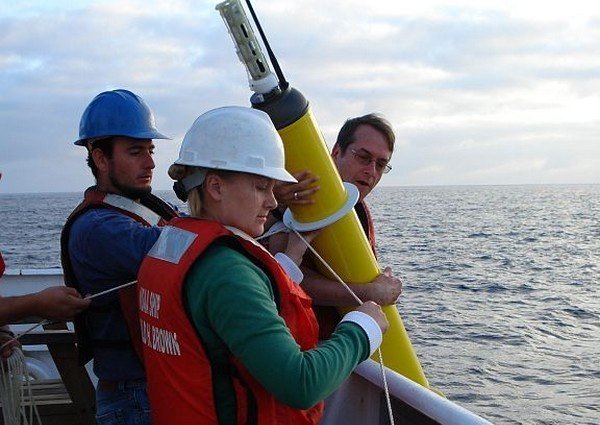
Scientists deploy an Argo probe. (Photo: Elizabeth Crapo, NOAA)

(Click to enlarge) Scientists deploy an Argo probe. (Photo: Elizabeth Crapo, NOAA)

Across the world’s oceans bob 3,500 free-floating instruments. Every ten days, the probes descend to 1,000 meters, drift, descend to 2,000 meters, and then rise to the surface. Along the way, they record up to 1,000 measurements of temperature, salinity and other key parameters. When the probes resurface, they beam the data up to satellites.

(From Gimby / Brooks Hays) – The Argo Program, as it’s known, aims to give scientists a more comprehensive understanding of the world’s oceans than ever before.

Late last year Argo logged its one-millionth “profile of the upper 2,000 meters of the ocean,” according to the National Oceanographic Partnership Program. What makes it different from other research projects is its ability to continuously monitor the ocean, according to Argo co-chair Dr. Dean Roemmich of the Scripps Institution of Oceanography.

“Argo has moved oceanography from the realm of regional data collection to global and systematic observation of the subsurface oceans,” Dr. Roemmich said in a statement.

Argo is a collaborative effort involving 28 countries; the U.S. is the largest single supplier of probes to the project. Scientists at U.S. Naval Research Laboratory, the National Aeronautics and Space Administration, the National Oceanic and Atmospheric Administration and elsewhere use the data to predict ocean behavior, forecast weather, and track climate change.

Now the program plans to send newly-designed probes to depths of 4,000 or even 6,000 meters in hopes of better understanding the ocean’s changing characteristics.

Teledyne Webb Research’s newest probe, the APEX, recently set a record off the coast of Hawaii’s Big Island by descending to well below 4,000 meters, as Hyrdro International reports. Telednye builds most of the program’s probes.

Want to dip your toe in some ocean science? Argo data is freely available on the project’s website.


Related Posts:

  • National Oceanographic Partnership Program Celebrates Argo One-Millionth Ocean Observation Milestone
  • Sunburst Sensors Wins Award to Build OOI pH and CO2 Sensors
  • TOPIC 3: Sensors for Measurement of Biological, Bio-Optical or Chemical Properties of the Ocean
  • Topic 2: Sensors for Measurement of Biological, Bio-Optical, Optical, or Chemical Properties of the Ocean
  • Gulf Stream ‘Is Not Slowing Down’
« Home | « Previous Page

Follow Us

Subscribe via Twitter
244 Followers
Subscribe via Facebook
271 Fans
Subscribe via RSS
68 Readers
Subscribe via Email
Subscribe

Upcoming Events

  • No events.

What's Hot This Month

  • NOPP Photo of the Month – Tagged N. Elephant SealNOPP Photo of the Month – Tagged N. Elephant Seal : The Northern elephant seal pictured has a CTD (conductivity, temperature, depth) tag attached to it by a team of Univers...
  • NOPP Funding Announcement in Partnership with DOE – Marine and Hydrokinetic (MHK) Effects Assessment and MonitoringNOPP Funding Announcement in Partnership with DOE – Marine and Hydrokinetic (MHK) Effects Assessment and Monitoring : NOPP is pleased to announce a new funding opportunity in partnership with the Department of Energy (DOE), Office of En...
  • NOPP Funding Announcement in Partnership with ONR – Earth System Prediction Capability-CLOSEDNOPP Funding Announcement in Partnership with ONR – Earth System Prediction Capability-CLOSED : NOPP is excited to announce a new funding opportunity in partnership with the Office of Naval Research (ONR)! Fundi...
  • Teachers Navigate the WebTeachers Navigate the Web : Vicki Clark remembers how she and other Sea Grant educators used to illustrate the powers and pitfalls of the Internet f...
  • Ocean Leadership Contracted to Help Manage the Gulf Research InitiativeOcean Leadership Contracted to Help Manage the Gulf Research Initiative : Gulf of Mexico Alliance Contracts Ocean Leadership to help manage the Gulf Research Initiative...
  • Program Update – March 2013Program Update – March 2013 : The National Oceanographic Partnership Program (NOPP) Office is pleased to announce a new funding opportunity in partner...
  • National Oceanographic Partnership Program Celebrates Argo One-Millionth Ocean Observation MilestoneNational Oceanographic Partnership Program Celebrates Argo One-Millionth Ocean Observation Milestone : Innovative Global Observing System Funded Under NOPP for First 12 Years...
  • Dr. Margaret Leinen New Chair of the Ocean Research Advisory Panel  (ORAP)Dr. Margaret Leinen New Chair of the Ocean Research Advisory Panel (ORAP) : The National Oceanographic Partnership Program (NOPP) office would like to welcome Dr. Margaret Leinen, Executive Direct...
  • Program Update – May 2010Program Update – May 2010 : The Biodiversity Ad Hoc Group, of the Joint Subcommittee on Ocean Science and Technology’s (JSOST) Interagency Working G...
  • Follow-on Research Article to the Attaining an Operational Marine Biodiversity Observation Network NOPP-Hosted Workshop to be Published in BioScienceFollow-on Research Article to the Attaining an Operational Marine Biodiversity Observation Network NOPP-Hosted Workshop to be Published in BioScience : Members of the steering committee from the 2010 NOPP-hosted workshop Attaining an Operational Marine Biodiversity Obse...

Archives

Visitors Online

2 Users Online

NOPP-Funded Project Websites

  • ARGO
  • BRIDGE
  • CHEMO III
  • DECAF
  • ECCO
  • FleetLink
  • GODAE
  • HYCOM
  • MISST
  • NearCoM
  • NOPP Drifters
  • OSTO Workforce Study

Recent Posts

  • Follow-on Research Article to the Attaining an Operational Marine Biodiversity Observation Network NOPP-Hosted Workshop to be Published in BioScience
  • Program Update – March 2013
  • NOPP Funding Announcement in Partnership with DOE – Marine and Hydrokinetic (MHK) Effects Assessment and Monitoring
  • NOPP Funding Announcement in Partnership with ONR – Earth System Prediction Capability-CLOSED
  • Argo Global Ocean Project Takes Underwater Monitoring to a New Level

RSS Latest From Ocean Leadership

  • New NOAA Report Examines National Oil Pollution Threat from Shipwrecks
  • Q&A: Blinding Us From Science
  • ONW: Week of May 13, 2013 – Number 202
  • Bob Gagosian – From the President’s Office: 5-16-2013
  • Lowering Ocean Temperatures Helps Save Coral Reefs

RSS Latest from ScienceDaily

  • Going green: U.S. equipped to grow serious amounts of pond scum for fuel
  • NASA’s BARREL mission launches 20 balloons
  • NASA's IRIS mission readies for a new challenge
  • NASA launching experiment to examine the beginnings of the universe
  • Radioactive nanoparticles target cancer cells
QR Code Business Card Web design by Will Ramos | © Copyright National Oceanographic Partnership Program (NOPP) 2007-2012. All Rights Reserved. | 120 queries in 0.436 seconds.